Research & scores
Find the Odd One Out: Why Similar Letters Slow Your Search
By HumanCalc · Published · 3 min read
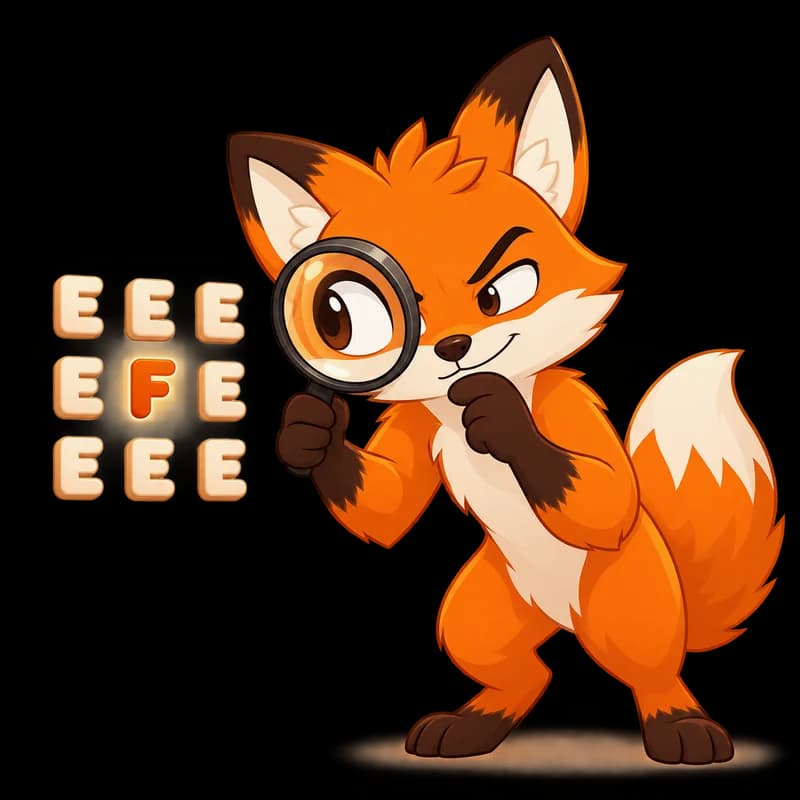
In Odd One Out, every cell of a grid shows the same character except one. You tap the one that is different before the clock runs out. Level 1 is a 6×6 grid, for example 35 copies of E and a single F. Level 22 is a 12×12 grid where the odd character is the same letter with one stroke slightly shorter or tilted.
Some of these grids feel instant and some feel impossible, even at the same size. Psychologists have studied this under the name visual search for more than 40 years, and their findings explain most of the difference.
When the odd one pops out
Treisman and Gelade (1980) showed that a target which differs from the rest by one simple feature, such as color, is found in about the same time however many other items are on the display. People describe the target as popping out. When the target can only be told apart by a combination of features, search time grows with every item added, as if each item has to be checked in turn.
Letters behave the same way. An X among Os differs in its basic shape and is found almost at once. An F among Es differs only in a missing bottom bar, so you have to look closer.
Q among Os is easier than O among Qs
Treisman and Souther (1985) found that search is asymmetric. A target that has an extra feature, like the tail of a Q among Os, is found quickly. A target that lacks the feature, an O among Qs, is found slowly. An extra mark catches the eye much more easily than a missing one.
Odd One Out uses this. The game picks at random which of the two characters fills the grid, so the same pair can produce an easy grid on one turn and a hard one on the next.
Similarity decides the difficulty
Duncan and Humphreys (1989) showed that search gets slower as the target becomes more similar to the other items, and faster when the other items are similar to each other. In Odd One Out every other cell is identical, which helps. The difficulty comes from the target: at higher levels it is a mirror image (b and d, p and q) or, from level 16, the very same glyph with one stroke changed.
How the game scales
Time per cell drops on every level, so the pace you need rises all the way. A wrong tap costs a life, and you have three.
| Level | Grid | Time | Typical difference |
|---|---|---|---|
| 1 | 6×6 | 7 s | E and F |
| 9 | 10×10 | 10 s | O and Q |
| 13 | 12×12 | 12 s | b and d |
| 16 | 12×12 | 11 s | Same letter, one stroke cut or shortened |
| 22 | 12×12 | 9 s | Same letter, one stroke shortened by 10% or tilted 6° |
How to scan faster
- Look at the whole grid for half a second before you start scanning. Pop-out targets are often found in that first look.
- If nothing jumps out, scan in rows and do not go back over a row you have finished.
- Before you start, decide what the difference will be. For E and F, watch the bottom edge. For b and d, watch which side the bowl is on.
- On the vector levels, look at the ends of strokes. A shortened or broken stroke shows at its end, not in its middle.
- Do not tap until you are sure. A wrong tap costs more than the second you spend checking.
Research sources
- Treisman & Gelade (1980): A feature-integration theory of attention
- Treisman & Souther (1985): Search asymmetry: A diagnostic for preattentive processing of separable features
- Duncan & Humphreys (1989): Visual search and stimulus similarity
- Wolfe (2020): Visual search: How do we find what we are looking for?
Try it now
Play Odd One Out in your browser
A grid of look-alikes. One is different. Find it. About 3 min. Free, no signup.
Play Odd One Out